
Behind the Scenes of an ITG Ideation Session
When it comes to running an ideation session, some of our clients say “how do you make it look so easy!” Others say, “I would be exhausted, how do you do it?” Either way, the answer is: there’s a lot that goes on behind the scenes to make an ideation session seamless, productive and fun!
Setting the objective:
First stop is the needs assessment. Every session we lead is custom-designed. That means we meet our clients where they are.
If you are looking for a blue-sky ideation session, we will design something broad and expansive.
If you have already done some work identifying JTBD, Opportunity Spaces or Dig Sites, we leverage that work in designing the sessions.
If you already have ideas, but they are not sure how well they fit with consumers’ needs, or where they fit into consumers’ lives, we design more of an optimization-style workshop.
The point is, we carefully craft every aspect of the session to ensure that the team is getting what they need.
Bringing in the voice of the consumer or customer:
Once we’ve designed the session, we need to get the bodies in the room. That calls for a collaboration between Facilitators, our clients, and our project management team. We have our own panel of ~400 Creative Consumers® associates across the country. And while creativity is the hurdle that these folks need to pass to participate in a session, they also need to be a part of your target audience, exhibit behaviors necessary to make their input as relevant as possible to the session, and be available to commit the time and energy we require for the dates of the project.
Since we manage the panel ourselves, it’s pretty quick to send out a poll with the necessary information and get back responses at lightning speed. And since we know the Creative Consumers® associates as individuals, we are able to hand-pick the ones best suited for the project.
If the scope of the specifications lies outside of our panel, we have a set of trusted recruiters who we work with closely to identify the creative participants needed - whether that’s patients, caregivers, small business owners, health care professionals, or even first responders(!), we find them, and we train them in creativity techniques to prepare them for the session. This training covers the basics that our Creative Consumers® associates learn so they have enough practice to get them ready to participate.
Securing a location:
Of course we have to figure out where to tell people to show up! Finding the right space is so important to a successful ideation session. If at all possible, and this is for most of our sessions, we work internally with our project management team to locate a spot that has a lot of space, light, nooks and crannies for break-out sessions, and if possible ties to a theme of the project in some way.
Some examples include:
A bar for a social beverage project.
A fun-plex for a teen candy project.
A large home with lots of bathrooms for an oral care project.
A space with a kitchen for a mini-meals and snacks project.
When a client team requires that we run the session on-site at their offices, we can do that too. Even then, we coordinate with the team to ensure the space will be conducive to the type of collaboration we are doing.
And then there’s the food! We make it a point to mix it up and provide something that’s healthy and hearty yet delicious, with options for specific dietary needs of both your team and the consumers. Sometimes it is like putting a puzzle together, but our project management team handles this with ease.
Prepping the consumers:
Our consumers work really hard before even showing up. For an ideation session to start off with positive momentum, it’s super important that the consumers come in ready to dive in and ideate. For that reason, we design a unique homework assignment for every single project we lead.
This assignment covers:
A wide variety of angles: emotions, usage, habits, desires, pain points.
Different types of exercises: mind maps, creative stories, visual expressions, metaphors.
Reflections to come in with insights and broad wishes.
And a whole host of other activities depending on the topic.
We compensate our consumers for several hours of work for the assignment. We like to joke that none of them do it “on the bus.” They take it seriously and it sets the stage for a very insightful and creative ideation session.
Working out the session flow:
We give a lot of thought to the session flow in advance of the project. And, a lot of what happens is based on what unfolds during the session, so we are always prepared to flex and pivot.
Prep includes everything from:
What kinds of stimuli will we leverage from the homework assignment?
What materials do we need to have on hand?
What types of excursions will work at the beginning of the session vs. the end of the session? For example group activities where we lead and teach how excursions work at the beginning, and paired exercises work better later on once everyone is comfortable.
When and how can we get people outside to get some fresh air?
What are some ways to get people on their feet? E.g. working on flip charts so they are not sitting too long.
When to infuse any client stimuli into the mix? Making sure it’s included at the right time so as not to limit expansive thinking.
Determining how ideas are captured:
Thankfully, we have our own idea capture tool called Forge, where clients and consumers can enter their ideas. But there are other considerations that we need to think about during the session.
The format of how ideas are entered counts. This is true sometimes more than other times, and we think that through too. For example, in a product ideation, ensuring “this is a ____” may seem basic, but you’d be surprised how many times participants want to say what something does or what it feels like, without saying what it actually “is.”
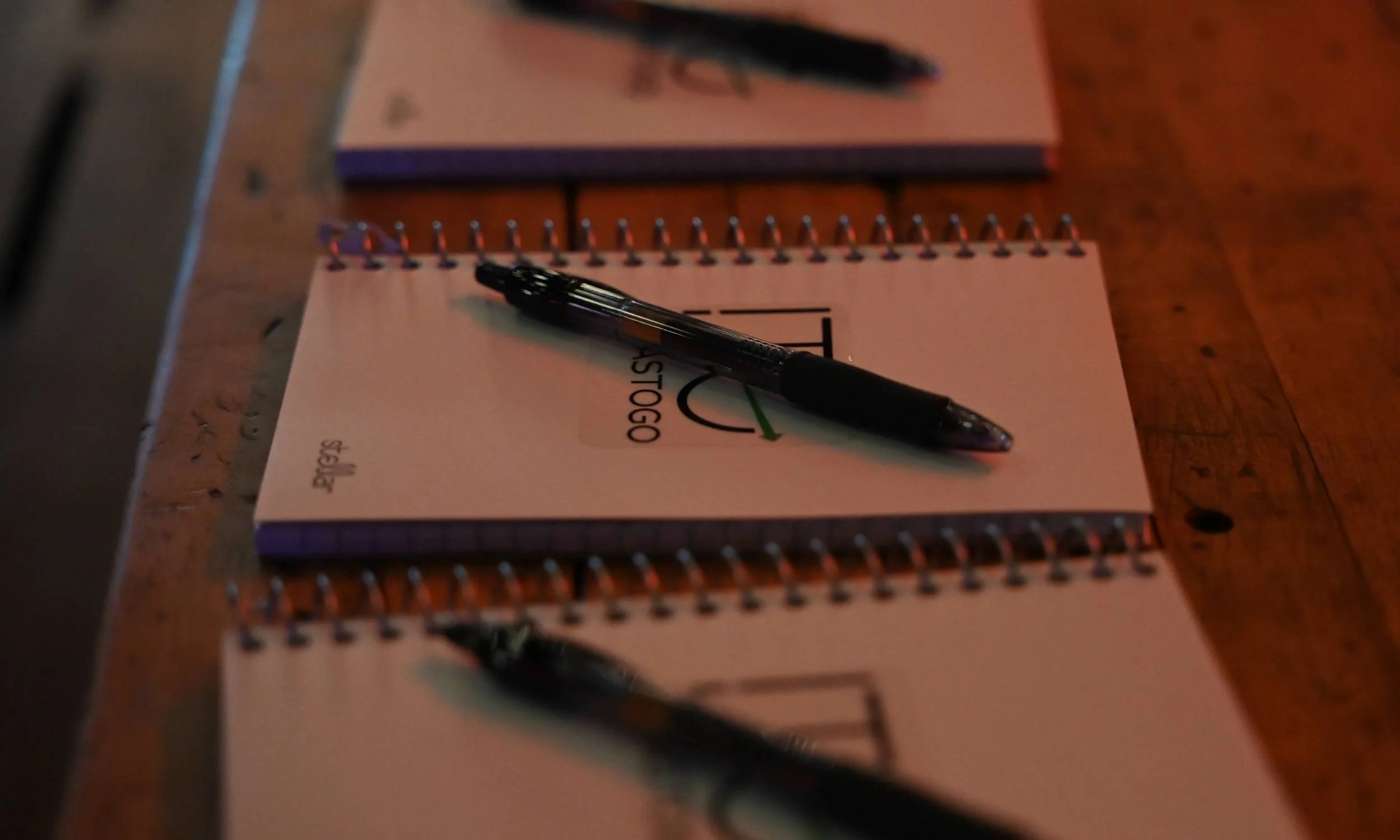
Note taking is key. We provide notebooks so that people can capture the stimulus during activities we provide to stretch thinking. These notes are not at the idea stage yet, and they are crucial to getting to ideas. But if they are not written down, it limits the amount of stimuli each person/team has to work with.
Other helpful analog tools. We use post its sometimes to share stimuli amongst the groups before ideas are generated, good old flip charts are a useful way to capture stimuli before and during idea generation, and the occasional worksheet can keep participants focused on the task.
The overall goal here is to ensure that all ideas are captured so nothing gets lost.
Converging on the ideas:
For the most part, we do follow two general guidelines during convergence, but that can even change depending on the objective and the size of the team.
Everyone votes.
Everyone submits a few starter concepts.
If it’s a multi-objective project, we may have people submit a few concepts against each objective, if it’s a huge team, we may have everyone limit their submission to one ultimate favorite, or if it’s a small team, we may have the consumers submit starter concept ideas to beef up the options.
We think through how to organize the outlines, by theme, by type of product, by benefit territory, it all depends on the objective, the desired output, and how the concepts wind up shaking out. We are usually talking about this part behind the scenes while our clients get a break.
Writing the concepts:
Each of us Facilitators writes hundreds of concepts each year. There’s an art to writing a good concept. It starts with a strong insight that is not just a benefit in reverse. We take great care in ensuring that our insights do not start with “I wish,” “I want,” or “I need,” and that the benefits, are both tied to the insight and more on the emotional side than the functional side. We have conversations with each other and with our clients about ensuring that the concepts are single-minded so the reader knows what they are reacting to. Sometimes we work over the course of a day or two to get those written, and at other times when the schedule demands, we’ll write them the afternoon and evening after voting, so we can review them with the team the next morning. Whatever you need, we’ve got you covered.
Moderating reaction groups:
Even our reaction groups have a lot of behind-the-scenes work going on. Of course we do the basics like recruit consumers and develop a discussion guide that covers general warm up questions, concept reactions, and probes. In addition to that, we usually have one facilitator lead the group while the other is taking notes to set up the debrief session, which happens right after the final group. This enables the your team to leave with a clear understanding as to which concepts performed best, and what needs to happen to improve the others. And then we make those changes the next day and send them back to you.
I hope this gives you a glimpse into the life of an ITG Facilitator and what goes on to set a project up for success. Assuming you don’t want to do all of this yourself, give us a call and we’ll be happy to start at the beginning to do it for you!